

Executive Summary
Counterfeiting has evolved into one of the most significant challenges facing modern brands. Once associated primarily with luxury goods sold through informal channels, counterfeit products are now distributed through sophisticated digital ecosystems spanning marketplaces, social commerce platforms, independent ecommerce websites, and global seller networks.
According to the latest OECD and EUIPO research, counterfeit and pirated goods account for approximately USD 467 billion in global trade, representing 2.3% of worldwide trade activity. While fashion and luxury brands remain heavily targeted, counterfeit operations increasingly affect cosmetics, consumer goods, electronics, sports merchandise, and many other industries.
For brands, the implications extend far beyond lost revenue. Counterfeiting impacts customer trust, marketplace performance, brand equity, pricing integrity, and operational efficiency. As e-commerce continues to expand and digital channels become more fragmented, understanding the scale and evolution of the counterfeit economy has become essential for every brand operating online.
This report examines the latest counterfeit statistics, emerging trends, industry-specific impacts, and the technologies shaping the future of brand protection.
The Counterfeit Economy Continues to Expand
Counterfeiting remains one of the largest forms of intellectual property infringement in the world. Despite increased enforcement activity from governments, customs authorities, online marketplaces, and brand owners, the global counterfeit economy continues to grow alongside international ecommerce.
Recent research from the Organisation for Economic Co-operation and Development (OECD) and the European Union Intellectual Property Office (EUIPO) estimates that counterfeit and pirated goods account for approximately USD 467 billion in global trade. This represents roughly 2.3% of total international trade and highlights the scale at which illicit commerce continues to operate globally.
These figures become even more concerning when viewed through the lens of ecommerce growth. As consumers increasingly purchase products through online channels, counterfeit sellers gain access to larger audiences, lower barriers to entry, and new opportunities to disguise fraudulent operations behind legitimate-looking storefronts.
However, focusing solely on market size risks overlooking a more important reality: the nature of counterfeiting itself has fundamentally changed.
Today's counterfeit operations look very different from those that existed a decade ago.
From Street Markets to Digital Counterfeit Ecosystems
Historically, counterfeit products were primarily associated with physical markets and unauthorized retail locations. Consumers often knowingly purchased counterfeit goods, understanding that they were buying imitations at significantly lower prices.
The digital economy has transformed this dynamic.
Modern counterfeit operations increasingly rely on online marketplaces, social commerce channels, independent ecommerce websites, messaging applications, and even influencer-driven promotion strategies. Consumers are now far more likely to encounter counterfeit products while browsing legitimate-looking online environments than while visiting informal physical markets.
This shift has created what many brand protection professionals now describe as a digital counterfeit ecosystem.
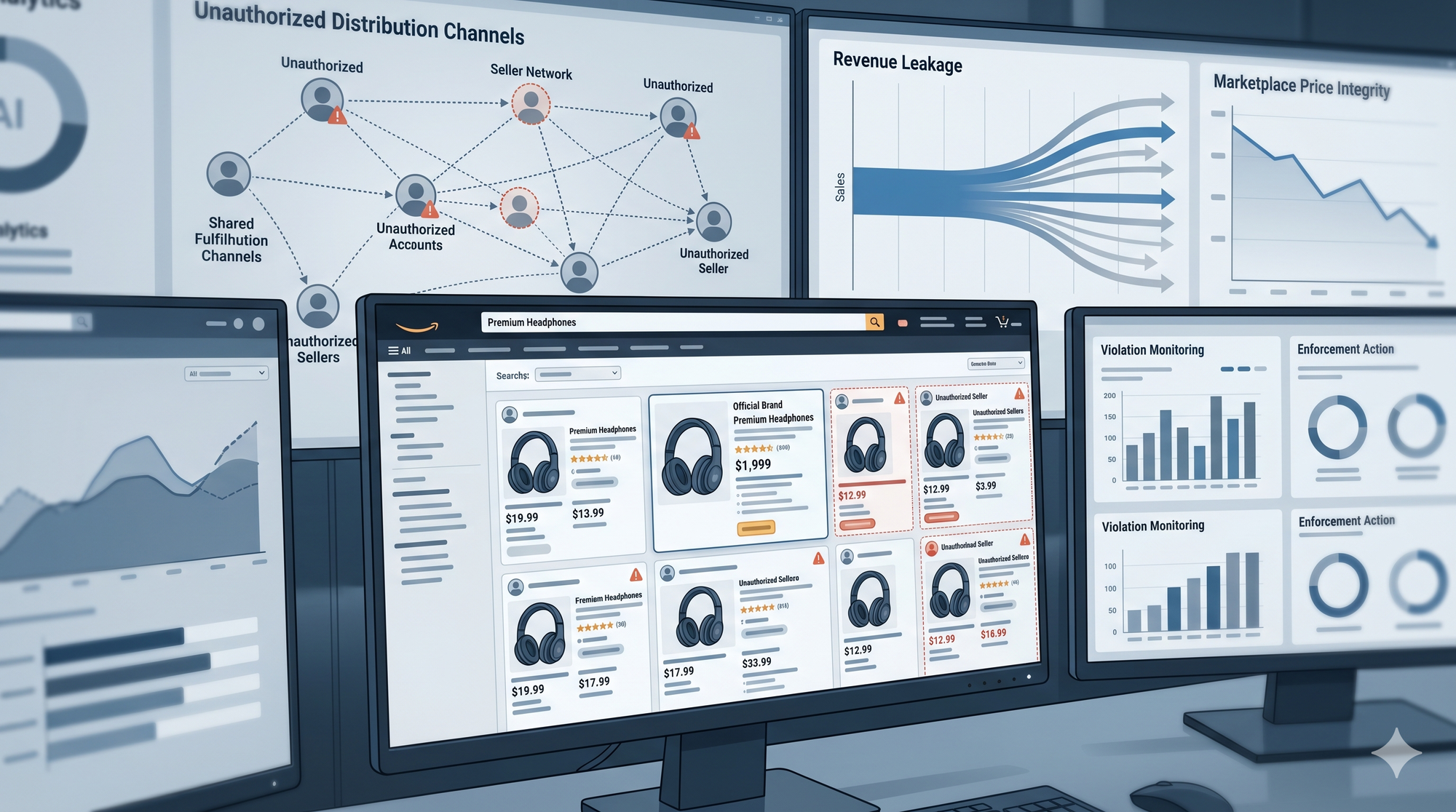
A single counterfeit operation may control multiple seller accounts across various marketplaces while simultaneously directing traffic through social media profiles and independent websites. If one account is removed, replacement accounts can appear quickly, allowing infringers to maintain visibility and continue generating sales.
For brands, this evolution introduces a significant challenge. Monitoring a handful of physical markets is fundamentally different from monitoring thousands of online sellers operating across dozens of platforms and jurisdictions.
As counterfeit distribution becomes increasingly digital, the range of industries affected continues to expand as well.
Which Industries Are Feeling the Impact Most?
Although luxury products often dominate public discussions around counterfeiting, the reality is that nearly every consumer-facing industry now faces some form of counterfeit risk.
Fashion and Luxury Continue to Be Primary Targets
Fashion and luxury brands remain among the most heavily targeted sectors worldwide. High consumer demand, strong brand recognition, and attractive profit margins make luxury goods particularly appealing to counterfeit networks.
Products such as handbags, footwear, apparel, watches, and accessories consistently rank among the most seized counterfeit categories globally. Beyond direct revenue loss, counterfeit luxury products can undermine exclusivity and weaken years of investment in brand building.
For premium brands, protecting brand equity is often just as important as protecting sales.
Cosmetics and Personal Care Products Present Safety Concerns
Counterfeit cosmetics represent a different type of risk.
Unlike counterfeit apparel, fake beauty and personal care products may contain harmful ingredients, contaminants, or unregulated substances. Numerous enforcement actions have uncovered counterfeit cosmetics manufactured outside regulated environments and sold through online channels that appear legitimate to consumers.
This creates a dual challenge for brands. In addition to intellectual property infringement, counterfeit cosmetics can expose consumers to serious health and safety risks.
Sports Merchandise and Football Jerseys Thrive Around Major Events
Large sporting events create ideal conditions for counterfeit sellers.
Demand for football jerseys, team apparel, scarves, and collectibles often surges around tournaments, championships, and new kit launches. Counterfeiters exploit this demand by flooding marketplaces with imitation products designed to capitalize on fan enthusiasm.
Because many purchases occur online, consumers may struggle to distinguish authentic merchandise from convincing replicas.
Consumer Goods Are Becoming Increasingly Vulnerable
Consumer goods manufacturers are experiencing growing levels of counterfeit activity across categories ranging from personal care products to household items and electronics.
Unlike luxury goods, these products are often purchased based on trust and reliability. When counterfeit versions fail to meet customer expectations, consumers frequently associate that negative experience with the legitimate brand rather than the counterfeit seller.
As a result, customer trust becomes one of the most valuable assets at risk.
Why Counterfeiting Has Become Harder to Control
The expansion of digital commerce has introduced new operational realities for brand protection teams.
Ten years ago, monitoring a relatively small number of marketplaces may have been sufficient for many organizations. Today, brands face a fragmented environment consisting of global marketplaces, regional marketplaces, social commerce channels, ecommerce websites, and emerging digital sales platforms.
The scale alone presents a challenge.
Thousands of sellers can list products simultaneously across multiple platforms, making manual monitoring increasingly unsustainable. Counterfeit sellers have also become more sophisticated, often operating networks of interconnected accounts designed to withstand enforcement actions.
Cross-border commerce adds another layer of complexity. A counterfeit seller may operate in one country, host a website in another, and sell products to consumers in dozens of markets simultaneously.
This growing complexity is forcing brands to rethink traditional enforcement strategies and adopt more intelligence-driven approaches.
The Shift Toward Intelligence-Led Brand Protection
The future of brand protection is increasingly defined by intelligence, automation, and data-driven decision-making.
Historically, enforcement efforts focused on identifying individual counterfeit listings and submitting takedown requests. While this approach remains necessary, it often addresses symptoms rather than root causes.
Modern brand protection programs increasingly seek to identify entire seller networks, uncover infringement patterns, and prioritize enforcement based on business impact.
Artificial intelligence is playing a central role in this transformation.
AI-powered monitoring systems can analyze product listings, seller relationships, trademark misuse, visual similarities, and marketplace activity at a scale impossible to achieve through manual review alone.
Rather than simply detecting counterfeit products, brands are beginning to build comprehensive visibility across broader online abuse ecosystems that include:
- Counterfeit products
- Unauthorized sellers
- Trademark infringement
- Fake websites
- Social media impersonation
- Pricing violations
This evolution reflects a broader industry shift toward proactive rather than reactive brand protection.
What Brands Should Be Paying Attention To Next
The counterfeit landscape is unlikely to become simpler in the years ahead.
Social commerce platforms continue to grow, creating new opportunities for counterfeit sellers to reach consumers directly. At the same time, advances in generative AI are making it easier to create convincing product imagery, seller profiles, and fraudulent storefronts.
As these technologies become more accessible, brands will face increasingly sophisticated threats that extend beyond traditional counterfeit listings.
The most successful organizations will be those that develop visibility across their entire online presence, understand infringement patterns, and leverage automation to scale enforcement efforts effectively.
One area deserving particular attention is the growing role of unauthorized sellers. While counterfeit products often receive the most attention, unauthorized seller activity can create similar challenges around pricing, customer trust, and brand control.
This topic will be explored in the next article in this series.
Key Takeaways
- Counterfeit and pirated goods account for approximately USD 467 billion in global trade.
- Counterfeiting now affects virtually every consumer-facing industry.
- E-commerce and social commerce have accelerated the distribution of counterfeit goods.
- Consumer trust is often impacted as much as direct revenue.
- Manual enforcement approaches struggle to scale against modern seller networks.
- AI is becoming essential for effective brand protection programs.
- Future brand protection strategies will require greater visibility across marketplaces, domains, social media, and seller ecosystems.
Frequently Asked Questions
How large is the global counterfeit market in 2026?
The latest OECD and EUIPO estimates place global counterfeit and pirated trade at approximately USD 467 billion, representing around 2.3% of world trade.
Which industries are most affected by counterfeit products
Fashion, luxury goods, cosmetics, sports merchandise, consumer goods, electronics, and personal care products are among the most frequently targeted industries.
Why has counterfeiting increased online?
E-commerce has lowered barriers to entry for counterfeit sellers while providing access to global consumer audiences and multiple sales channels.
Are counterfeit products only a luxury brand problem?
No. Counterfeiting increasingly affects consumer goods, electronics, cosmetics, sports merchandise, and many other sectors.
How are brands using AI to combat counterfeit products?
Brands use AI to monitor marketplaces, identify seller networks, detect trademark misuse, analyze product images, and prioritize enforcement actions at scale.
References
OECD & EUIPO. (2025). Mapping Global Trade in Fakes 2025.
OECD. (2025). Global Trade in Fake Goods Reached USD 467 Billion.
European Union Intellectual Property Office. (2025). Mapping Global Trade in Fakes.
World Customs Organization. (2024). Illicit Trade Report.
Interpol. (2024). Intellectual Property Crime Assessments.