

Executive Summary
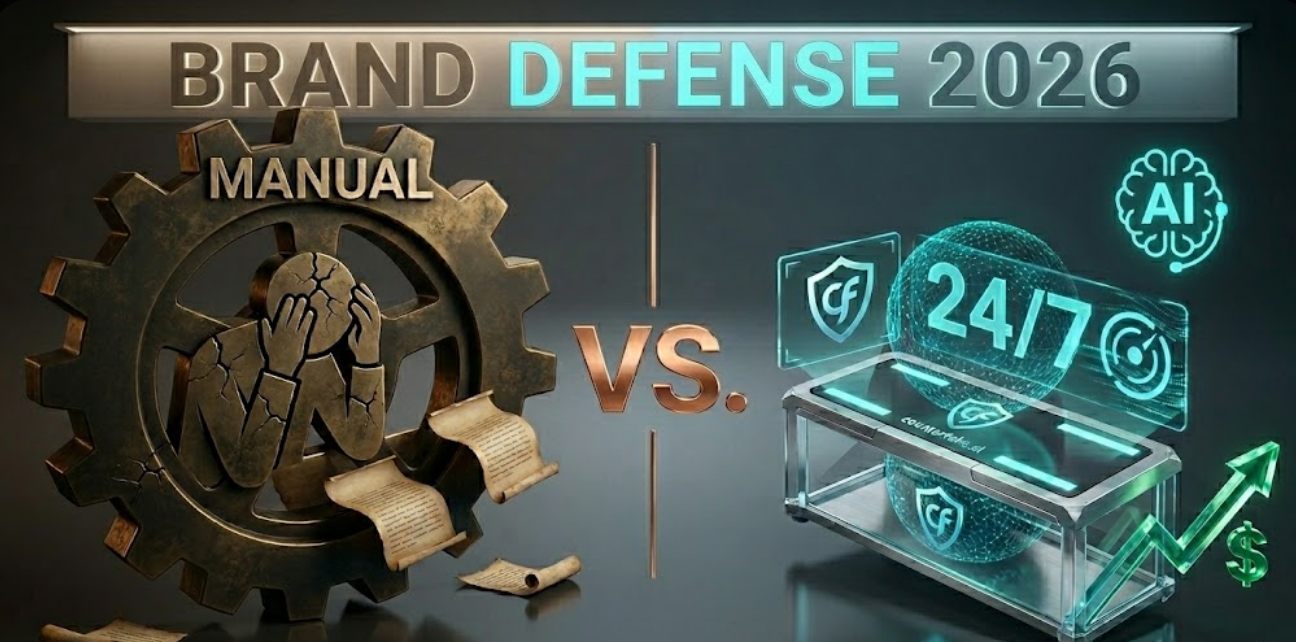
In 2026, brand protection is no longer a reactive legal function—it is an operational necessity tied directly to revenue, customer trust, and market expansion. As global e-commerce continues to scale, manual monitoring methods cannot keep pace with the speed, volume, and coordination of counterfeit networks. According to OECD and EUIPO findings, counterfeit trade remains a multi-hundred-billion-dollar global issue, increasingly embedded in digital channels. This article examines the real cost of manual brand protection compared to AI-driven systems, analyzing scalability, operational efficiency, response time, and risk exposure. It also explains how Counterfake’s AI-powered brand protection software enables 24/7 monitoring across marketplaces, domains, and social platforms—transforming brand defense from reactive enforcement into proactive digital risk intelligence.
--
The Scale Problem: Why Manual Monitoring Breaks Down
Global digital commerce has expanded dramatically over the past decade. The OECD and EUIPO report that counterfeit and pirated goods account for an estimated 2.5% of global trade, representing hundreds of billions of dollars annually (OECD/EUIPO, Trade in Counterfeit and Pirated Goods). As commerce shifts further online, counterfeit activity follows.
Manual brand protection typically relies on:
- Keyword searches on marketplaces
- Periodic domain checks
- Manual social media reporting
- Reactive legal enforcement
This approach worked when the number of sales channels was limited. It fails when:
- Thousands of new sellers appear daily
- Listings are created and removed within hours
- Counterfeiters operate across multiple jurisdictions simultaneously
- Algorithm-driven advertising amplifies fake products
According to Interpol’s Illicit Goods and Global Health Programme, counterfeit operations are increasingly organized, fast-moving, and digitally coordinated. Manual teams simply cannot match that velocity.
The Real Cost of Manual Brand Protection
Manual monitoring carries visible and hidden costs.
1. Labor Costs
A typical in-house brand protection team includes:
- Monitoring analysts
- Legal specialists
- Marketplace enforcement staff
Even a modest operation requires multiple full-time employees. Salaries, training, and legal support compound annually.
2. Detection Lag
Manual processes introduce time delays:
- Listing discovered days after publication
- Legal notices processed manually
- Platform response times extended
During this lag, counterfeiters generate revenue and damage brand trust.
The U.S. Patent and Trademark Office (USPTO) has emphasized that delayed enforcement significantly weakens trademark protection, especially in fast-moving digital environments.
3. False Positives and Blind Spots
Humans miss patterns at scale.
They also struggle with:
- Lookalike domain variants
- Cloaked listings
- Visual-only logo misuse
- Coordinated multi-platform activity
The Cybersecurity & Infrastructure Security Agency (CISA) notes that automated threat actors often operate at speeds and volumes that exceed human detection capacity.
AI-Driven Brand Protection: Operational Advantages
AI-powered brand protection software transforms monitoring from manual review to continuous intelligence.
Counterfake provides:
- 24/7 automated monitoring
- Marketplace and social platform scanning
- Domain risk detection
- Visual recognition of logo misuse
- Coordinated seller pattern analysis
Rather than searching for keywords alone, AI systems analyze behavioral signals, metadata anomalies, and visual inconsistencies.
Speed: AI reduces detection time from days to minutes.
Scale: Instead of monitoring hundreds of listings manually, systems analyze thousands simultaneously.
Pattern Recognition:AI identifies coordinated seller behavior, repeated IP addresses, and suspicious account creation patterns.
This shift is critical. As the World Intellectual Property Organization (WIPO) highlights, digital enforcement requires technological adaptation to counter organized infringement networks.
ROI: Measuring the Difference
When comparing manual vs AI-driven brand protection, the ROI discussion includes:
Factor
Manual Monitoring
AI-Based Monitoring
Coverage
Limited
Multi-platform
Response Time
Delayed
Near real-time
Labor Cost
High
Lower long-term
Pattern Detection
Reactive
Predictive
Scalability
Constrained
High
OECD data consistently shows that counterfeit trade exploits regulatory gaps and enforcement delays. Reducing detection lag directly reduces exposure.
Traditional brand protection asks:
“Where is the fake product?”
Modern AI-driven systems ask:
“What pattern suggests a coordinated counterfeit campaign?”
This shift from listing-level detection to ecosystem-level analysis is crucial.
Counterfake’s system focuses on:
- Behavioral fingerprinting
- Cross-platform signal aggregation
- Continuous risk scoring
The objective is not only removal—but prevention.
Counterfake’s approach integrates continuous scanning with actionable insights, enabling brands to respond strategically rather than reactively.
Why 2026 Is a Strategic Turning Point
E-commerce growth projections from the European Commission indicate continued expansion in cross-border digital trade. According to WIPO and OECD analyses, enforcement strategies must modernize to keep pace with organized digital infringement. As barriers to entry decrease, counterfeit networks gain easier access to global consumers.
At the same time:
- Social commerce is rising
- Micro-seller ecosystems are expanding
- Influencer-driven marketplaces blur the line between formal and informal retail
Manual brand protection is not obsolete but it is insufficient alone. They introduce friction into global expansion. Without scalable monitoring, brand exposure multiplies.
Brands entering new markets in 2026 must evaluate:
- Jurisdictional enforcement complexity
- Platform-level compliance requirements
- Digital ad vulnerabilities
AI brand protection becomes not just a defensive mechanism, but a growth enabler. For brands planning expansion, investing in scalable brand protection infrastructure is no longer optional it is foundational to sustainable growth.
References
- OECD & EUIPO – Trade in Counterfeit and Pirated Goods: Mapping the Economic Impact
- World Intellectual Property Organization (WIPO) – World Intellectual Property Indicators
- Interpol – Illicit Goods and Global Health Programme Reports
- U.S. Patent and Trademark Office (USPTO) – Trademark Enforcement Guidelines
- Cybersecurity & Infrastructure Security Agency (CISA) – Digital Threat Monitoring Reports
- European Commission – Digital Single Market & E-commerce Reports
- World Health Organization (WHO) – Reports on Counterfeit and Substandard Products